

What a Battery Test Chamber Reveals About EV Batteries
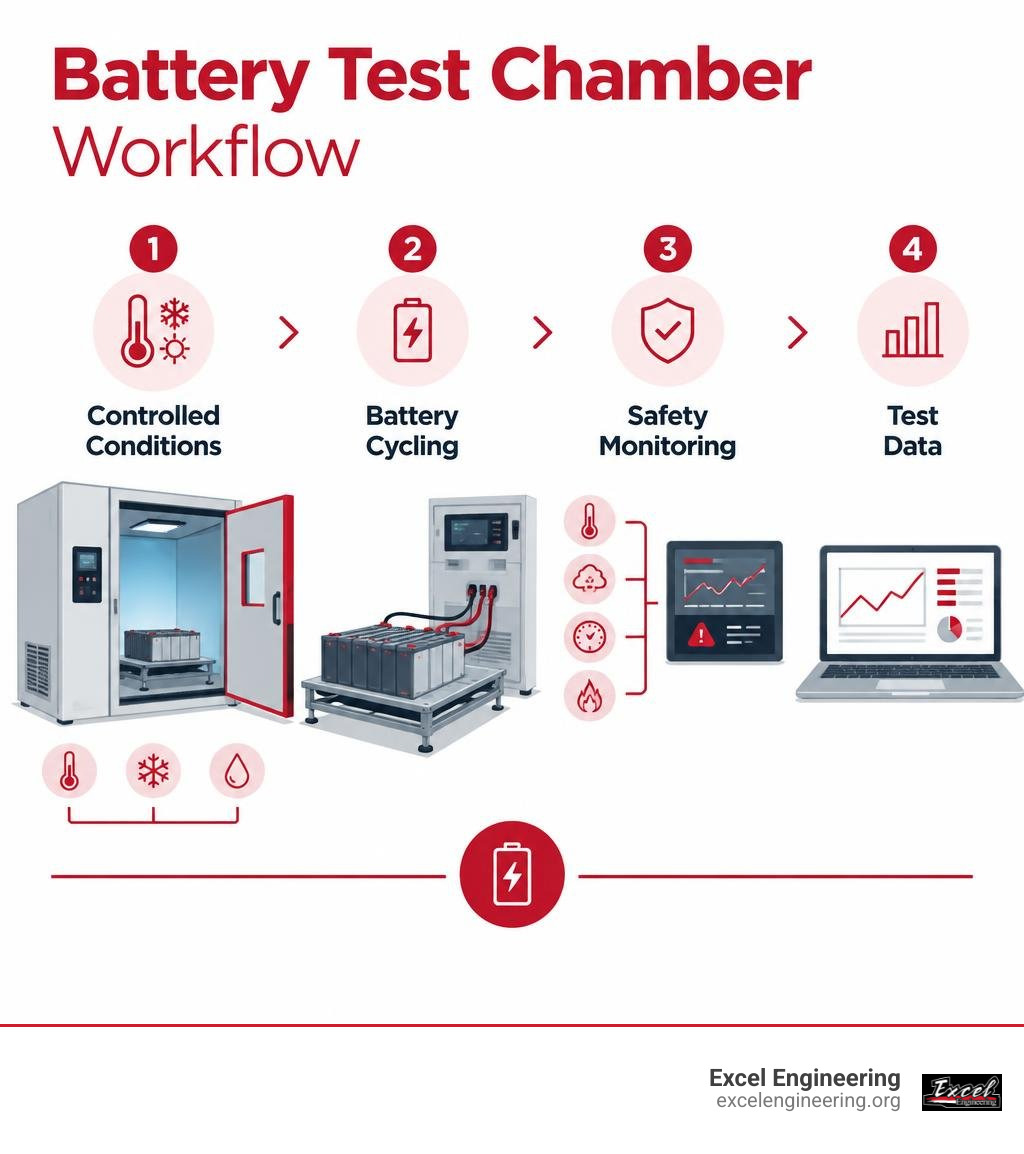
A battery test chamber creates a controlled environment for testing how cells, modules, or packs respond to heat, cold, and, when needed, humidity. Paired with a battery cycler, it lets engineers measure performance during charging and discharging under repeatable conditions. Chambers built for higher-risk tests also need safeguards to manage smoke, gas, pressure, and heat if a battery fails.
For an OEM, the value is straightforward: reliable test data helps teams spot problems before a battery reaches the vehicle. This guide covers chamber types, safety features, test standards, and the specifications that matter when planning a test.
I’m Matthew Sobotka, General Manager at Excel Engineering and a former Electrification Testing Manager. From more than 14 years in engineering and manufacturing, I’ll explain how a battery test chamber fits into EV battery validation.
Core Classifications of the Modern Battery Test Chamber
Evaluating modern energy storage systems requires distinct testing environments. Depending on whether you are verifying baseline electrochemical capacity or pushing a pack to its absolute chemical breaking point, the enclosure you select must match the specific stresses of the test profile.
Temperature and Climatic Chambers
Standard environmental profiling relies heavily on temperature-only and temperature-and-humidity enclosures. These systems evaluate how lithium-ion cells behave during continuous operational cycling across global climate zones, ranging from sub-zero winter cold soaking to scorching desert heat.
In temperature-only chambers, testing typically spans ranges from -20°C to 80°C for standard benchtop units, while heavy-duty environmental systems extend from -70°C up to +150°C (or even +180°C). Tight temperature stability (frequently within ±0.5°C) and micro-circulation airflow ensure that internal temperature gradients remain under ±1°C to ±2°C across all test channels.
Climatic chambers introduce active humidity control, typically operating across a 10% to 95% relative humidity (RH) spectrum with tight control tolerances around ±2% RH. Active dew-point management and heated humidity sensors prevent moisture from condensing directly onto high-voltage busbars and sensitive terminal connections. This level of environmental simulation is essential when validating HV battery systems against real-world corrosion, thermal shock, and insulation degradation.
| Chamber Type | Typical Temperature Range | Humidity Range | Typical Heating/Cooling Rates | Primary Use Case |
|---|---|---|---|---|
| Temperature-Only | -20°C to 80°C (or -70°C to +150°C) | N/A (Ambient dry air) | 1°C to 3°C/min | Thermal capacity, internal resistance, and standard cycle-life validation |
| Climatic (Temp/Humidity) | -20°C to 80°C | 10% to 95% RH | 1°C to 2°C/min | Moisture ingress, insulation resistance, and environmental stress profiling |
| Thermal Abuse | Ambient up to 200°C | N/A | 5°C ±2°C/min (Linear) | Separator stability testing, bake testing, and runaway trigger evaluation |
| Explosion-Proof Containment | -70°C to +150°C (up to 180°C) | Optional | 1°C to 3°C/min | High-energy cycling, destructive overcharge, short-circuit, and physical abuse tests |
Thermal Abuse and High-Heat Chambers
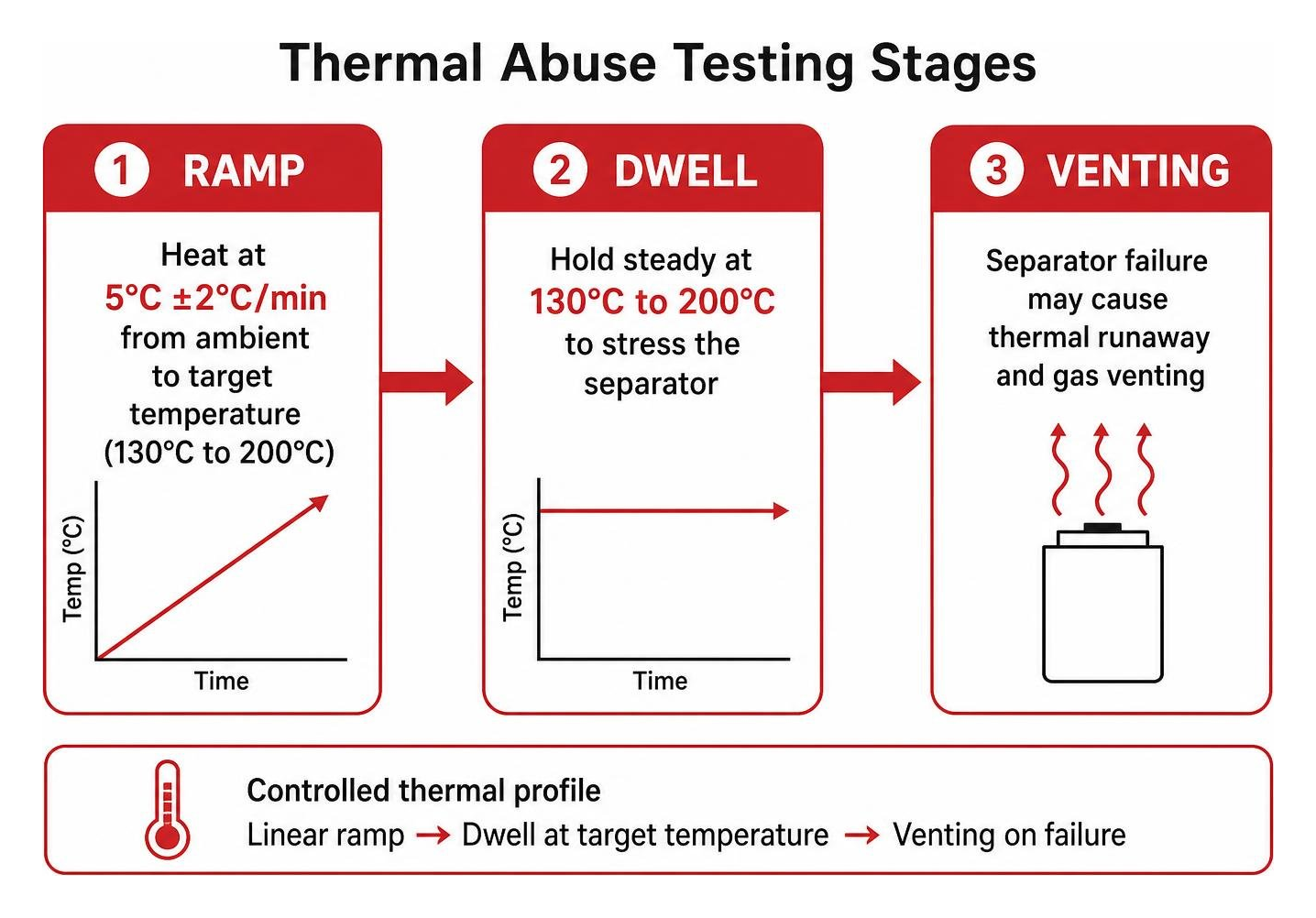
Thermal abuse chambers subject cells and sub-modules to severe external heat loads to evaluate safety margins. Regulated testing profiles (such as those under UL 1642 or IEC 62133) require chambers to heat lithium-ion cells at a rapid, controlled ramp rate—typically 5°C ±2°C per minute—from ambient temperatures up to a steady dwell temperature of 130°C to 200°C.
Achieving this linear ramp rate under thermal mass loads requires substantial heating power (often 6 kW to 12 kW) driven by solid-state relays (SSR) paired with proportional-integral-derivative (PID) controllers. These tests intentionally stress the internal polyolefin separator. If the separator shrinks or melts, internal short circuits occur, triggering thermal runaway. A dedicated thermal abuse chamber isolates this intense reaction, measuring the precise onset temperature of runaway while safely exhausting flammable off-gassing.
Essential Safety Architecture and Hazard Mitigation
Testing lithium-ion cells involves inherent chemical risks. Destructive failures release dangerous levels of carbon monoxide, hydrogen, and volatile hydrocarbons, accompanied by rapid pressure spikes and extreme thermal discharge. Managing these events is central to comprehensive EV battery testing and safety validation.
Engineers select reinforced enclosures, such as Explosion Proof Test Chambers for Battery Testing, to protect laboratory staff and facility infrastructure during destructive testing.
Critical Safety Mechanisms in a Battery Test Chamber

High-risk battery chambers are designed to contain high-energy mechanical and thermal events. Key structural safeguards include:
- Automatic Pressure-Relief Ports: Calibrated mechanical blast vents and burst disks open instantly when internal chamber pressure spikes, releasing pressure safely toward overhead ducting before the door seal or outer walls can rupture.
- Heavy-Duty Door Restraints: Reinforced explosion-proof locking chains and dual mechanical latches keep the chamber door sealed during sudden internal overpressure events.
- Multi-Layer Observation Windows: Viewing ports use multi-layer vacuum glass reinforced with integrated stainless steel wire mesh. This construction stops high-velocity projectile fragments if a cell casing ruptures, while embedded anti-fog heating elements keep sightlines clear.
- Spark-Resistant Airflow Systems: High-temperature circulation blowers and internal circulation motors use sealed, spark-resistant designs to prevent electrical arcing from igniting combustible battery off-gases.
These physical containment features align directly with the European Council for Automotive R&D (EUCAR) hazard framework, designed to withstand catastrophic events up to EUCAR Hazard Level 7.
Fire Suppression and Gas Evacuation Systems
Passive blast containment must be paired with active fire suppression and atmospheric controls:
- Early Gas and Smoke Detection: Optical smoke detectors and integrated electrochemical sensors continuously sample the internal atmosphere for trace hydrocarbons and carbon monoxide, detecting cell venting before open flames develop.
- Inert Gas Purging: When abnormal temperature or gas spikes occur, automated safety systems flood the interior volume with inert gas (such as nitrogen or argon) or deploy dedicated fire-extinguishing agents to suppress combustion.
- High-Volume Exhaust Ventilation: Dedicated exhaust blowers capable of moving 450 cubic meters per hour or more vent hazardous off-gassing directly into laboratory scrubber infrastructure.
- Automated Power Disconnects: Built-in no-fuse breakers (NFB), over-temperature interlocks, and emergency stop relays instantly isolate electrical power from both the chamber heating elements and the external cycler circuits.
Technical Specifications and Chamber Sizing Considerations
Selecting an environmental chamber requires balancing internal test space volume against thermal mass, airflow speed, and heating and cooling ramp rates. Standard laboratory chambers range from compact 28-liter benchtop units to walk-in rooms exceeding 1,000 liters.
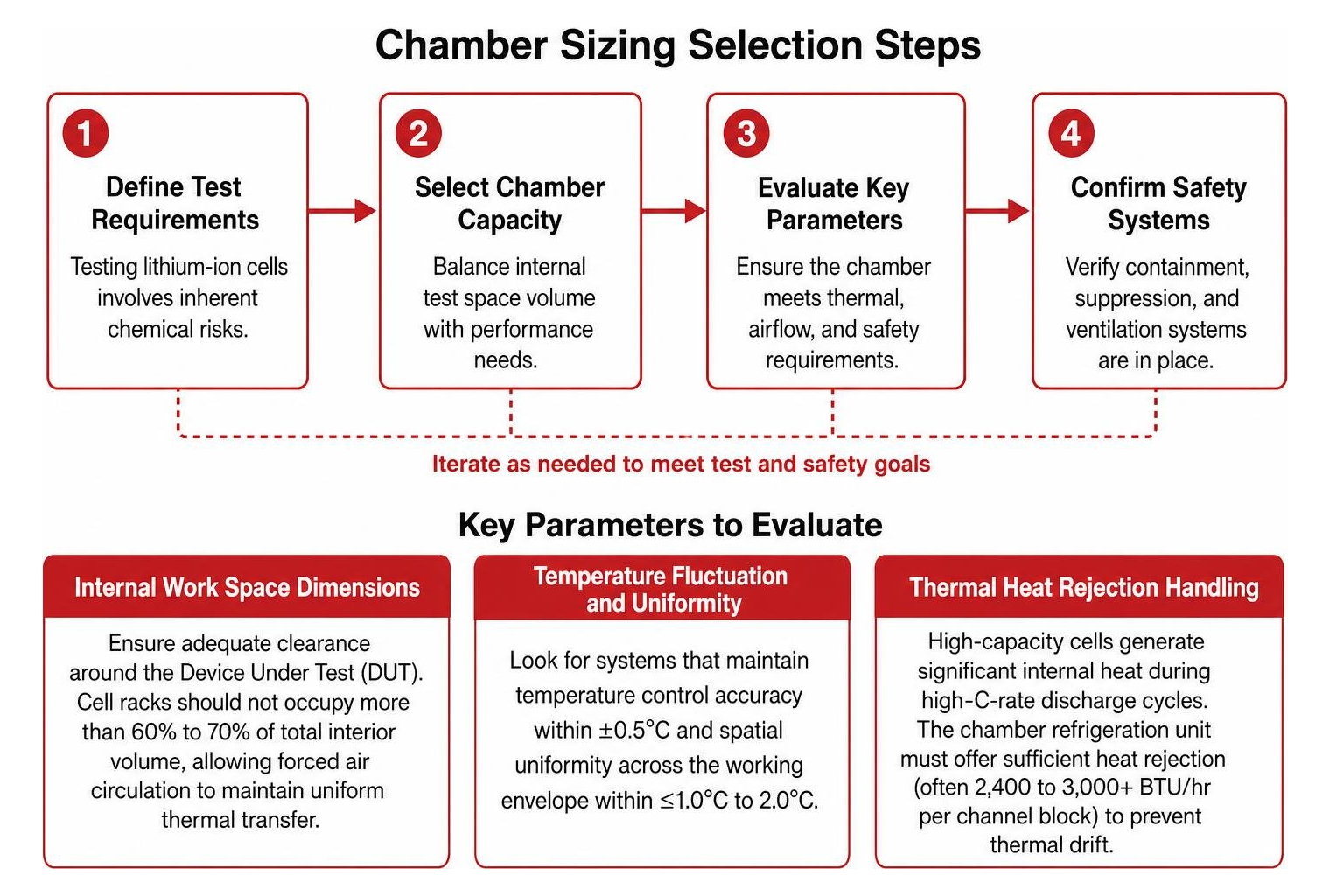
When sizing an environmental test setup, evaluate these core parameters:
- Internal Work Space Dimensions: Ensure adequate clearance around the Device Under Test (DUT). Cell racks should not occupy more than 60% to 70% of total interior volume, allowing forced air circulation to maintain uniform thermal transfer.
- Temperature Fluctuation and Uniformity: Look for systems that maintain temperature control accuracy within ±0.5°C and spatial uniformity across the working envelope within ≤1.0°C to 2.0°C.
- Thermal Heat Rejection Handling: High-capacity cells generate significant internal heat during high-C-rate discharge cycles. The chamber refrigeration unit must offer sufficient heat rejection (often 2,400 to 3,000+ BTU/hr per channel block) to prevent thermal drift.
- Heating and Cooling Rates: Standard rates typically average 3°C/min for heating and 1°C/min for cooling under no-load conditions. Ensure refrigeration compressors are sized to maintain these transition speeds when loaded with high-density metal fixtures.
- Electrical Safety & Isolation: Power leakage protection, door safety interlocks, and auxiliary backup thermostats prevent runaway conditions if primary digital controllers encounter faults.
Integrating Cyclers and Controls in a Battery Test Chamber
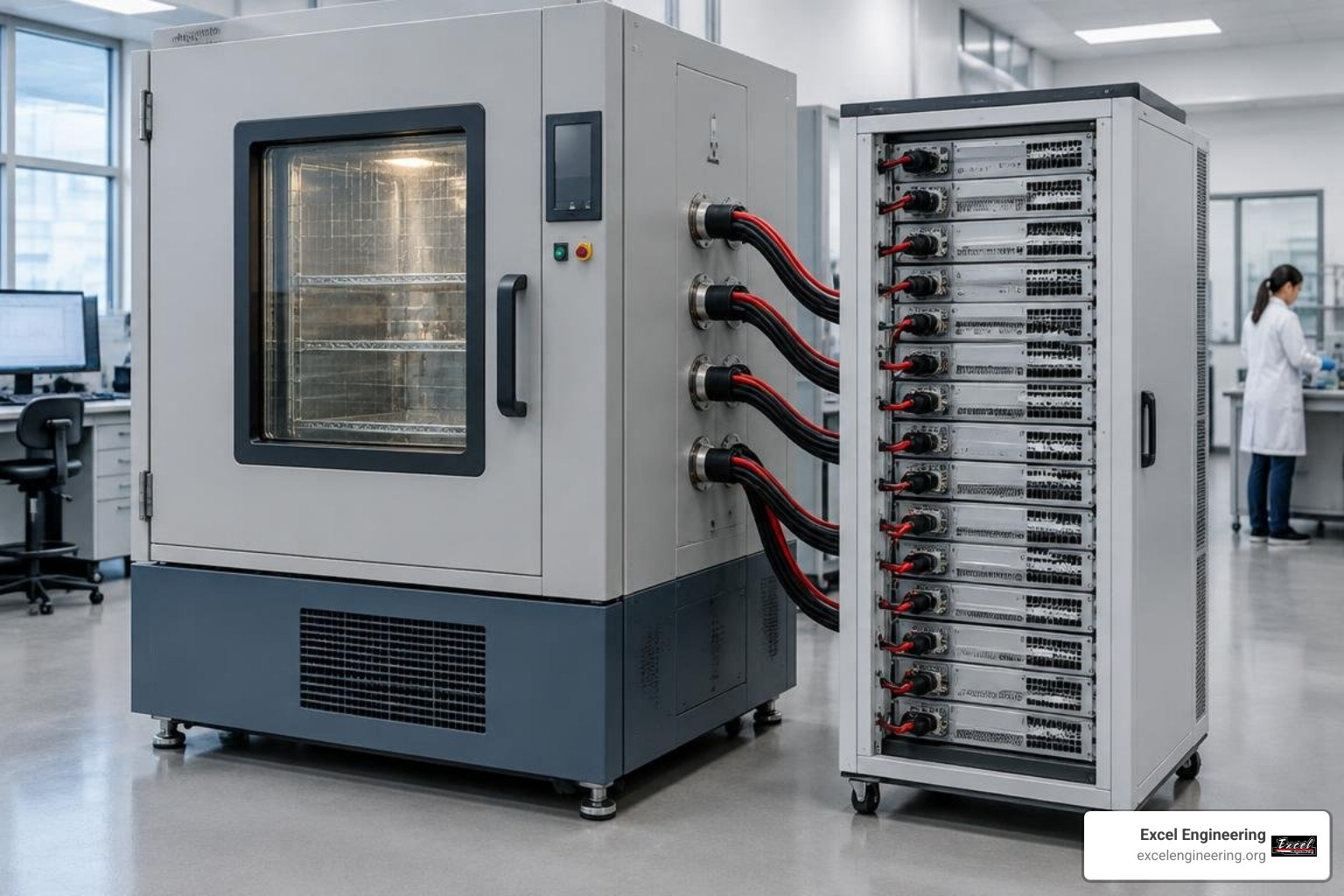
A chamber cannot operate in isolation; it must integrate seamlessly with multi-channel battery cyclers, DC electronic loads, and thermal data acquisition systems. Pass-through access ports (typically 50 mm to 100 mm in diameter) lined with non-conductive, silicone-sealed thermal plugs allow high-current cabling to connect external power channels to internal battery fixtures.
Modern automated validation platforms use RS485, CAN bus, or Ethernet communication protocols to synchronize the environmental chamber directly with the cycling software. Through central controllers, engineers program complex test matrices where cycling steps automatically adjust based on internal chamber conditions or real-time cell skin temperatures gathered from auxiliary Type-T or RTD thermocouples. In addition to testing standard traction packs, specialized test setups support additional testing services across auxiliary hybrid power units and balance-of-plant components.
Regulatory Compliance and Industry Testing Standards
Compliance testing ensures that energy storage systems meet strict international transport, safety, and durability regulations. Validated chamber test profiles serve as the foundation for these regulatory frameworks:
- UN 38.3 (Transport Safety): Mandates thermal cycling tests that alternate between -40°C and +75°C to confirm cells and battery packs will not rupture or leak during global air and ground transport.
- UL 1642 and UL 2580: Define standards for consumer and automotive lithium cells, requiring rigorous thermal abuse baking, overcharge, and short-circuit verification inside contained environments.
- IEC 62133 and IEC 62619: Global benchmarks for portable and stationary industrial secondary storage cells, setting pass/fail criteria for high-heat retention and electrical abuse behavior.
- SAE J2464 and ISO 12405: Automotive standards detailing electric propulsion safety testing, including thermal runaway propagation limits, mechanical shock, and extreme environmental cycling.
Executing these standardized qualification matrices in certified facilities supports responsible manufacturing, validating battery safety while reinforcing broader goals of environmental stewardship.
Frequently Asked Questions About Environmental Testing
What is EUCAR Hazard Level 7 in battery containment?
The European Council for Automotive R&D established a hazard classification system from Level 0 (no effect) to Level 7 (explosion). Hazard Level 7 describes a catastrophic event involving an uncontrolled chemical reaction, violent rupture, explosion, and projecting battery components. Chambers engineered to survive Level 7 include heavy blast containment, reinforced doors with safety chains, multi-layer blast glass, and high-volume automatic pressure relief systems.
How does micro-circulation maintain thermal uniformity across battery cells?
Micro-circulation utilizes balanced, spark-resistant blower systems that route conditioned air through engineered plenums across the chamber’s interior walls. This forced horizontal or vertical airflow prevents localized hot and cold pockets from forming around dense battery fixtures, keeping temperature deviations across multi-cell arrays within a tight ±1°C window.
What maintenance ensures long-term test chamber accuracy?
Maintaining test reliability requires a regular maintenance routine:
- Quarterly Sensor Calibration: Calibrate RTD sensors and Type-T thermocouples against reference standards to prevent setpoint drift.
- Door Gasket Inspections: Clean and check silicone or magnetic door seals for hardening, tears, or micro-cracks that cause thermal and moisture leaks.
- Pressure-Relief Verification: Inspect mechanical pressure-relief vents, burst disk assemblies, and exhaust dampers to ensure they move freely without residue buildup.
- Refrigeration Servicing: Clear dust from air-cooled condenser fins, check compressor oil levels, and ensure refrigerant charges meet factory operating specifications.
Validating Battery Safety and Reliability
Rigorous environmental testing turns early battery designs into dependable, road-ready power systems. By subjecting cells, modules, and packs to controlled thermal stress, high-risk abuse profiles, and continuous cycling inside specialized test chambers, engineering teams identify failure modes early and ensure full regulatory compliance.
Whether you are validating small consumer cells or industrial high-voltage platforms, maintaining consistent test repeatability and safe containment is paramount. To explore how our ISO 17025-certified facilities and testing services can support your next development program, contact our engineering team at the Excel Engineering advanced battery testing center.
— Matthew Sobotka, General Manager, Excel Engineering